Saturday, April 8, 2017

About Writing and Evaluating Patents

"Good to the righteous and good to his neighbor, woe to the evil and woe to his neighbor. Like a person that enters a perfume shop, even if he does not sell or buy, even if he does not touch anything - the smell sticks to him and does not leave him all day. The same with leather shops."
In other words - the environment influences, the environment matters.
This is a proverb from our scriptures.

IBM topped the annual list for patent recipients for the 24th consecutive year!
Being part of this leading company, makes me develop expertise in the field too.
Currently I'm an IDT (Invention Development Team) Board member. Also known as "Patent Review Board".
Our duties are to:
1. Identify and evaluate patentable inventions
2. Help/mentor inventors to make their inventions the greatest
3. Advise the IP (Intellectual Property) Law on the technology and business merits of the invention

When I first attempted to invent patents, they failed under the constrains of "non-obviousness", "novelty" or "useful". Though the definitions of the constrains was clear to me, it wasn't always clear why some patents are "patentable" while others are not.
I knew I acquired the skill of "patent evaluator" when I succeed convincing my patents-mentor about the patentability of a patent which he did not think was patentable (see hidden milestone).

Being a "patent evaluator" would not happen without my colleagues and my dear mentors for patenting:

  • Omri Fuchs, my first team leader at IBM-Research, He was the first to expose me to the patent application process.
  • Sima Nadler, inventor & founder of a product I worked on, who taught me what is considered a patent.
  • Orith Toledo-Ronen, whom I shared an office with, presented patents data bases and taught me how to use tools in order to verify that new inventions ideas are novelty.
  • Roie Melamed, my former team leader that mentored me towards implementing patentable algorithms
  • Suzanne Erez (IPLaw Counsel), performing annual mandatory courses for new comers and increasing awareness for the importance of patents.
  • Anat Laufer (HR Partner), who told me about the IDT Board.
  • Flora Gilboa Solomon, my former manager that connected me to the right experts I was looking for (IDT-Board Leaders).
  • Gilad Mintzer-Magal (Advocate & Patent Attorney), performing seminars related to patents & always up to answering questions.
  • Michal Jacovi (IBM Master Inventor, Cognative Analytics and Solutions Invention Department Team Lead), who let me be a guest in the IDT Board in order to learn the process behind.
  • Tal El-Hay (IBM Master Inventor, Health Informatics Invention Department Team Lead), who accepted me as a member in the IDT Board
  • And of course, all board members, for hearing them arguing about the patentability of candidates-patents.
  • And especially Aharon Abadi (IBM Master Inventor, IDT Board member) that generously shares his vast knowledge and always lends a helping hand. We had lots of discussions related to patents.


My first framed certificate

Monday, April 3, 2017

IBM's New Offices in Israel


I had the chance to visit the new building today.
The interior design is so colorful and joyful with an adaptive environment e.g., configurable tables.
There are private offices (no "open space" -- hooray!)

There are also cool places for meetings


 And cool places for informal meetings

Can't wait to move!!!

P.S - The view from the windows does not fall from IBM's standard (see below). What do you think?
IBM-Research Haifa
IBM-XIV (Azriely Floor 38)
The New Building
Migdaley HaShahar (floor 21)
This is currently the second tallest occupied building in Israel.

Thursday, March 2, 2017

What it means to be a Researcher

Some will say, that a researcher is someone that publishes papers and is a member of a science community. They will tell you about reading and writing papers, citations, surveys, reviews, related work, evaluations, latex, conferences, workshops, collaborations, grants, postdoc, etc...

For me, a researcher is a character. A character of someone who has curiosity for knowledge and to reveal the unknown. Curiosity that leads him to ask "how could it be?"  and the courage to say "I will solve this". He also needs integrity and humbleness to say "I did not solve it yet". Research is like looking for something in a dark room, using the sense of touch. The chances for finding what you are looking for in the first try is low. So it requires patience and grit.
A researcher also has imagination full of innovation that leads towards a vision. The enthusiasm for the idea gives a sense of responsibility for carrying out this vision to become true. To build the path from the theory to its conception. A path which no one ever walked through. That makes the researcher a pioneer and one who inspires others, and requires of him to be ingenious and inventive to overcome the obstacles up and coming.

As I see researchers, they care less about monetary profit and more about having a place to express their capabilities and to bring something new to the world (it could be in the form of a published scientific paper and it could also be by creating a new product or imparting a new habit).

I aspire to be a great researcher!

Monday, December 26, 2016

Work-Life Balance

One of the things I like in the high-tech is that there are no strict start and end hours in the work day. I usually prefer working in the early morning hours so that I can be available for family time in the late after-noon. Although the convention is long days, generally there is the flexibility to combine very-long-days & short-days. I use this option in case there are special needs at work or at home. To handle urgent matters at work, I may dedicate evenings or nights working from home. I've noticed that this is probably a typical parent's timing profile. Those without children at home usually prefer to start late and to stay at work until the evening (or until night in urgent cases), not taking work with them to their home.

Once in a while I start late or finish earlier than usual in order to join one of my kids in kindergarten or at school. I sit with all the other children around the table and draw with them or tell them a story. This is really fun for me, and my kids LOVE it. All the other children and the teacher also enjoy the unexpected change in their routine. In those moments I'm the coolest mother.

Me as 'Rabbi Kalman' from the Hanna Zelda story for Hanukkah last week.


Happy holidays!

Sunday, December 11, 2016

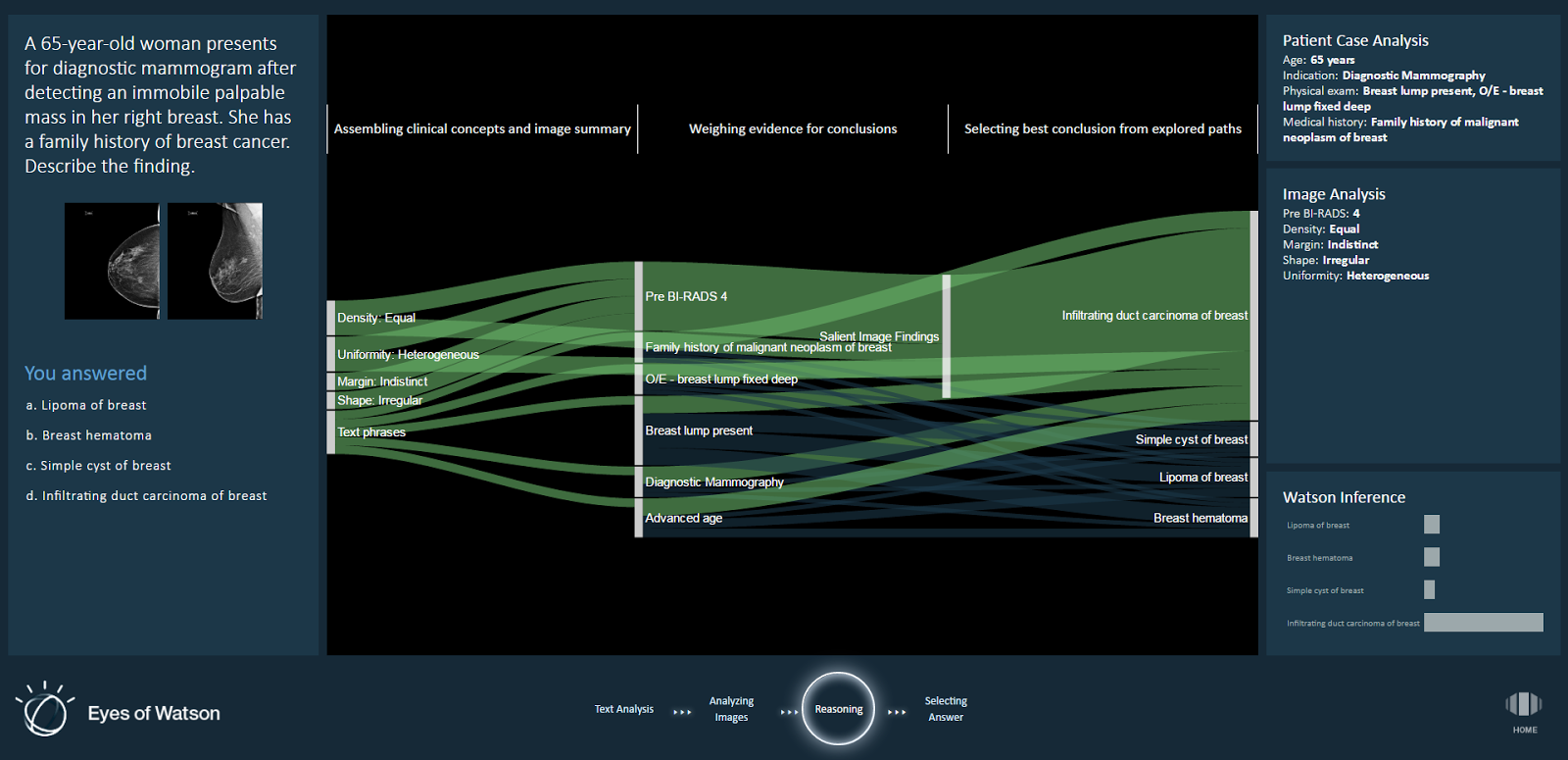
Eyes of Watson

I have been really busy. For the last months, I was drawn into a great project at work that will potentially change the world. It will change the way computers "see". It will change the way we will get medical treatment.

Last week we made history by achieving our first big milestone - presenting Eyes of Watson at the RSNA conference.

In short, this system is a long term project to build the next generation cognitive assistant with advanced analytics and reasoning capabilities for clinical diagnostics.

Below we can see some snippets with explanations:

A case contains a clinical description of a patient, the patient's mammogram images, and a textual question for the system to answer.


The clinical description is analyzed.


The images are analyzed.


The inference on the analyses, based on reasoning algorithms.


The system's findings to answer the question.

Thursday, July 28, 2016

Milestones

A milestone is something that you can achieve, that you can describe and you can quantify. It's like an anchor,  like a point that you can say you got to.
I got this simple explanation from the CTO (Chief Technology Officer - the most important technical person in the company). He then asked me (I was the project manager), to set milestones and supply a timetable.
I was a rookie in the industry straight out of the university. I had the privilege of managing a project because I was part of a startup. At startups there are a lot of opportunities because startups must manage with what they have.

Anyway, milestones are applicable in various domains that have long continuous processes. Milestones help us track progress. For example when a baby grows and develops, in order to quantify his development we have milestones such as "the first time the baby turns over" or "the first steps".
At these points we can say "oh.. he's developing!" and we note them.

Professional development has its own milestones. Some of them are obvious like finishing the first year at university, getting the bachelors degree, masters, PhD, the first day at work, etc. Some milestones are hidden, like the first time selling a big idea to a colleague/manager or the first time looking for a new job in stealth.

Several weeks ago I celebrated some of my own milestones.
I had my first business trip where I presented (in front of an international audience) a paper of which I was the main author. I conducted conversations with other researchers, fluently, with confidence as an expert in my field.
That was a really exciting experience.

(below - me presenting, the place and the audience)


Friday, June 24, 2016

The difference between men and women


The previous post raised several interesting comments and I wanted to share two links :

Google Expects Different Answers From Men and Women on a Question Used to Predict Job Success
  •  Men tend to overestimate their capabilities and to be less self-aware, as compared to women. In an interview, a man is preferred if he shows that he has something to learn. The hypothesis is that a man's success and his tendency to be more self-aware are positively correlated.
  • For Women however, the hypothesis is that there is much societal pressure to be self-effacing and humble and to hang back, be modest and wait until they are certain rather than raise their hand at the first opportunity like men tend to do. Therefore if a woman says she’s great, first of all she’s probably going to have a higher EQ and better social perceptiveness. And second — she’s gonna be amazing! And, indeed, that’s what google see.

Sheryl Sandberg - Why we have too few women leaders , Sheryl advises women:
  • Sit at the table - Do not underestimate yourself, negotiate, understand and believe in your own success, and believe that you deserve it!  (And literally, don't sit in the corner of the room.)
  • Make your partner a real partner - Call for equal responsibility at home.
  • Don't leave before you leave - If you are thinking of having a child - do not lean back yet. Once you start to lean back, your job becomes less challenging and you are going to be bored and will have less of an urge to return after your leave. Don't make decisions too early.